


Urban Exploring



EXPLORING ABANDONED URBAN STRUCTURES LEFT IN DEEP FORESTS OR OPEN FIELDS HAS DEVELOPED INTO A SOCIAL PHENOMENON REGARDLESS OF WHETHER IT IS DANGEROUS OR PERMITTED.
In 1957, two F-86 Saberjet fighter aircraft from Davis-Monthan Air Force Base met in a midair collision. Covered with moss, broken up and withering away between the dirt and roots of trees, the two planes now reside in the deep forests of Mount Bigelow.
According to the Green Valley Recreation Hiking Club, officials determined that the removal of the wreckage would be expensive and require the use of helicopters, so the decision was made to leave the remains where they landed.
Jeremiah Barnett, a frequent hiker and urban explorer, recounts his experience when he visited this site and places like it.
“If I am just hiking along the trail I am looking forward to seeing things in nature, like plants and animals,” Barnett told Spark. “Then all of the sudden you come across a mine or a big hole in the ground or a plane wreck, and it is not really supposed to be there.”
Barnett describes the feeling of seeing man made objects in nature as eerie.
“Man has gone in and left his footprint,” said Barnett. “It’s a little unsettling, but it’s still interesting at the same time.”
Although there are no bones or remaining signs of life from those who died there, Barnett still recounts feeling frightened just knowing the history behind what he explored.
Urban Exploration
Exploring abandoned urban structures left in deep forests or open fields has developed into a social phenomenon- regardless of whether it is dangerous or permitted.
For photographer and lifelong backpacker Zack Weinstein, exploration is about reconnecting with the natural world rather than breaking into the forgotten corners of the manmade one.
“I was always into the outdoors and was like a wild animal growing up,” Weinstein told Spark. “I knew how to fish and shoot from my dad and best friend’s step dad.”
In high school, Weinstein was fortunate to have an elderly man in the community who shared similar interests, and inspired Weinstein to pursue his own.
David was a well traveled environmental engineer and became local to the community due to Armco, a steel manufacturer based out of Weinstein’s hometown. He ran an organization that encouraged outdoor activities for youth and promoted civic engagement.
“We backpacked at Red River Gorge, went to the boundary Waters Canoe area, and traveled to the wilderness in Minnesota with backpacks and a canoe,” said Weinstein.
Weinstein describes himself in his youth as wild and troubled, being in nature seemed to remedy this. Being forced to eat healthy foods while on these trips, along with fresh air and exercise, brought him dietary regulation and normal sleep cycle in his life.
“I realized immediately that backpacking was actually the natural way for a human being to survive,” Weinstein told Spark. “Waking up and walking until you naturally find healthy organic food, eating, sleeping, and doing it again every day of your life is much healthier and more natural than the lifestyles today’s human beings find in American society, especially.”
Growing up in nature led him to find his passion for photography.
“Photography is a natural part of being outdoors and backpacking in general for most people,” Weinstein said.
After years of struggling, Weinstein realized he could make a living in photography by centering his shoots around people: senior photos, engagement announcements, and wedding photography.
However, Weinstein adds his own personal element in every picture that he takes.
“I get to enjoy taking pictures in the greatest places in the world, all the destinations where people want their picture taken,” Weinstein told Spark.
As a photographer who specializes in nature photography, Weinstein has had plenty of close calls, and he does not take the easy way out of them.
“One time I [was going down a hill] and accidentally hit my foot with a hatchet,” said Weinstein. “I had to hike myself out and drive myself three and a half hours home, with a stick shift and a big hole in my foot.”
He has also been stuck in the deep woods during thunderstorms, when “lightning was cracking 50 feet over my head with no shelter.”
Weinstein has also had some scary encounters with wildlife, including rattlesnakes, brown bears, and several mountain lions. Another especially harrowing time was when he was chased across a lake by a bear.
Trespassing
Through all of those dangerous encounters, the one thing Weinstein would never risk as a photographer is trespassing.
“Even for the sake of art it is not okay to trespass,” said Weinstein. “You can get shot these days; you probably will and you would likely would deserve it.”
Butler County Officer Sendes defines trespassing and breaking and entering according to the Ohio Revised Code for criminal trespass.
“No person without the privilege to do so, shall do any of the following: enter or remain on the land or premise of another or knowingly enter or remain on the land or premises of another,” Sendes told Spark.
When simplified, the main points of the Ohio Revised Code for criminal trespass boils down to one main theme: a person cannot be on someone else’s property without express permission.
The exact penalty one could receive for trespassing differs from case to case, but Sendes provides a few common ones in which most are convicted.
“Depending on the section and then the subsection, it can be a misdemeanor of the fourth degree,” Sendes said, “but can be up to a misdemeanor of the first degree.”
He continues that once charged, based upon what subsection is violated, various penalties, fines, jail time will vary.
The Legality of Exploring
Although there may be some legal stipulations, Weinstein’s photography has its own set of rules.
“It is not illegal to take a photo in a public place, you are expecting you do not have any [amount] of privacy in public,” said Sendes.
This does not mean that anyone can go to any crowded place and take photos and videos though, different restrictions are placed on different businesses.
“Walmart has a corporate policy that you may not film there,” Sendes told Spark. “So the most that they can do is say ‘hey, you need to leave.'”
According to Sendes, a property that appears abandoned does not mean it is open to the public.
“Unless it’s owned by a government entity, somebody owns it, therefore making it private,” said Sendes.
Sendes uses the Cincinnati Mills Mall as an example. Opened in 1988, it was once the second-largest mall in Ohio. Unfortunately, after suffering from financial problems due to declining tenants, it is closed. The demolition of the mall began late this year, but before this it was a popular spot for urban explorers.
With its extensive size, unique architecture, and eerie feel, people liked exploring its abandoned halls and unique features like the sandpit and arcade.
“[The mall] was a big place when it finally closed down and now nobody’s there,” Sendes told Spark. “Many people may not know who the owners are, the police may not even know who the owners are, necessarily.”
Despite this, the property is still private and depending on the property. The measures put in place to keep people out will vary the charge from criminal trespass to possible breaking and entering, which is a felony.
Property Owners
Sendes does believe that there is a safe and legal way to appreciate abandoned spaces without the risk of breaking the law by trespassing; Sendes tells citizens to do their research.
“Learn as much about the property as you can,” Sendes said. “You can go to the Butler County auditor’s website and do a property search.”
He also suggests reaching out to the owners themselves.
“You can find owner information from [the Butler County auditor’s website] and see if you can reach out and contact the owners [as they might have] phone numbers and names listed,” Sendes told Spark. “It is all public record.”
He heavily recommends that one explains to the owners the plan he/she has.
“You can explain that you do not want to do any damage or anything like that, just maybe take photos or whatever it is,” Sendes said. “Just to appreciate the property that [the land owner has] and get permission from them.”
Local hiker and hunter Jason Spatz recounts an experience he had with trespassers as a property owner.
“My family owns a lot of property, and there have been several people that have tried to hunt on that property,” said Spatz. “When I was there hunting, I ran into those people (tresspasser), it was very weird seeing somebody where they are not supposed to be, especially when they have a gun and you have a gun and you are not exactly happy that they are there, and they are not exactly happy that you found them.”
When Spatz is faced with this situation, he recounts that he tells them to go away, and if they do not, he threatens to call law enforcement. Thankfully for him, he has never had to get the police involved.
When it comes to exploring territory he is unfamiliar with, Spatz uses modern technology to avoid the risk of trespassing.
“Both my GPS and my phone tell me exactly where private property is,” Spatz told Spark.
Historial Exploration
Spatz shares a time he was exploring in Arizona and found a historical footprint left by men during World War II.
During World War II, rumors spread that Japan was going to bomb Phoenix. American officials decided to put lights on the top of the White Tanks, a mountain range to the west of Phoenix.
“Those lights were to basically trick the Japanese into thinking that they were homes,” Spatz said. “In hopes that if Japan ever bombed Phoenix, that they would bomb that area, being confused that that was where the homes were.”
When he was on a backpacking hunting trip, Spatz found the lights that were installed in World War II.
In fact, Spatz installed a swimming pool for a woman whose dad used to work on top of the White Tanks he found, employed under a company called Caterpillar Testing Hill.
“They used to take their machines up there and test them. And he used to drive up that hill every day,” Spatz said. “And he’s been dead for quite some time, but he worked on those exact same white tanks that I backpack hunt on and that I found those lights on.”
When Spatz explores these abandoned, urban spaces, he takes a picture and connects with the history.
“This last year, I found geographic markings,” Spatz told Spark. “These forest guys used to go out, and they used to mark the forest [and] the public land with these markers that had the longitude and latitude on them.”
Urban legends are a modern genre of folklore that consists of fictional stories associated with ghosts, superstitions, and fear generating elements. Urban legends are closely linked to urban exploring, since these abandoned and forgotten places foster a perfect environment for the creation of these myths.
Cryptids are common examples of urban legends, as cryptids are animals whose existence has been suggested but is not verified by science, such as the Lochness monster.
Hosted in Kentucky, the Covington Cryptid Block Party featured over 50 small business vendors offering food, drinks, or handcrafted goods all based upon urban legends.
Every product sold was inspired by myths; for example, a candle shop run by Errant Viridia offered products focusing on the Pope Lick Monster and Bigfoot.
“I have always really liked the story of the Pope Lick Monster because it is a Kentucky based cryptid,” Viridia told Spark. “As for Bigfoot, I felt like I could not leave out one of the most well-known cryptids, and it was an excuse to play with forest scents.”
The Pope Lick Monster is a part-man, part-goat, and part-sheep creature that allegedly lives under the Pope Lick Creek in Louisville, Kentucky.
Viridia heard about the Pope Lick Monster in the early 2000s.
“[When I] came across it the first time it stuck since I grew up near a much smaller train trestle over a creek similar to the one where the monster lives,” said Viridia.
Another small business that worked as a vendor for the Covington Cryptid Block Party is Ethan Lace, artist and founder of LaceCreations.
“So far I have done artworks of the Loveland Frogman, the Chupacubra, the Ohio Grassman, [and others],” Lace told Spark.
Lace was inspired to do the cryptid-themed work by just knowing the organizers and wanting to support them.
“I had a great time! The vibes were pleasant and I did good business,” said Lace.
He described it as an escape from the monotony of day to day life and could feel a smile on his face throughout the experience.

THE OHIO STATE REFORMATORY IS RUMORED TO BE A HAVEN FOR PARANORMAL ACTIVITY AFTER ITS DARK PAST.
Within the hollowed halls of the Ohio State Reformatory (OSR) lies decades of dark history. Rumors of ghosts haunt the reputation of the building, with many people reporting hearing voices, tapping, and scratching.
Built in 1896, the OSR was originally created to hold inmates who were too old for juvenile corrections but had committed minor offenses. The goal of the building was to reform and rehabilitate its inmates by educating them on religion and trade.
In the early 1960s, things began to change. The state pulled its financial support and began converting the OSR into a maximum security facility. Prisoners were transferred from a State Penitentiary in Columbus, but there were not enough cells. Many maximum-security prisoners were sent up to the attic due to lack of room. Inmates were often tortured and held in bad conditions as a way to “reform” them. The building stayed this way for about 20 years before inmates began suing Ohio for the deteriorating conditions, according to the OSR website.
“Punishments included the ‘sweatbox,’ water tubes, and ‘the butterfly,’ an electrical shock device,” according to the OSR website. “These torturous methods contributed to the prison’s legacy of misery and suffering, creating an environment ripe for ghostly activity.”
In 1990, a new facility was built, and the original location at 100 Reformatory Rd was abandoned. Eventually, the Mansfield Reformatory Preservation Society purchased the facility from the state for $1 and began repairing the structure.
The Reformatory is now home to the Ohio State Corrections History Museum, which consistently exceeds 120,000 visitors per year, according to the OSR website. The museum most commonly catches the attention of paranormal enthusiasts and ghost hunters alike, including Monroe Firefighter Ashton Conte, his sister Alivia, and their group of paranormal investigators.
“It felt darker than some of the other places we visited,” Alivia Conte told Spark. “It’s hard to tell what’s my nerves psyching me out and what’s real, but there was definitely [paranormal activity] there.”
On Aug. 5, 2024, the investigators visited the OSR late at night, hoping to find paranormal activity within the dark halls. The night began as they expected, voices or tapping here and there, but the evidence of a haunting became more apparent as the night progressed.
“We had two guys who were non-believers when they walked in,” Ashton Conte told Spark. “After watching a male shadow figure appear and walk through one of the walls, they started crying.”
When they visited the solitary confinement area, a rock was thrown at them, hitting a piece of metal next to Ashton. According to Ashton, the most activity was in the infirmary, East Cell Block, and attic, where he found multiple shadow people.
“[To the non-believers,] I say you should rethink that,” said Ashton. “I’m not here to change your mind, I’m not going to argue with people to try and convince them. Until you have that experience, you’re just oblivious to what’s out there.”
THE ALMOST TWO-HUNDRED-YEAR OLD CINCINNATI SUBWAY SYSTEM RESTS DORMANT UNDER THE BUSTLING CITY, POSSIBLY CONTAINING THE SECRETS OF A BYGONE ERA.
Downtown Cincinnati, Ohio looks like a regular urban area; however, a secret is buried underneath the busy streets. The forgotten, abandoned Cincinnati subway system lies concealed under the Queen’s City.
The subway was built in 1920 over a seven year period, and the entire project cost around about $6 million. The subway was originally built to both replace the ineffective Miami Erie Canal and expand the reach of an interurban railway system, according to Allen Singer, author of “Cincinnati Subway: History of Rapid Transit.”
“[The city] decided to create a rapid transit system,” Singer told Spark. “It was built to deliver people from downtown quickly to the suburbs and interurban trains [located outside of] downtown.”
However, transportation methods continued to evolve at a rapid rate.
“The interurban trains all died out before they even got construction started on the subway,” History reporter, columnist, and librarian Jeff Suess told Spark. “With the changing types of transportation, and in particular the shift to cars, Cincinnati started to have to build up streets and freeways, and suddenly, a subway wasn’t as necessary anymore.”
Ultimately, due the popularization of the automobile and political changes, the subway was never finished and abandoned.
“Cincinnati’s needs changed,” said Singer. “New roads were being built, [and people] stopped relying so much on the street cars and interurban trains.”
Today, the subway system consists of two empty tunnels about two miles long, and includes four unfinished stations. The tunnels loop around downtown Cincinnati, mainly located underneath Central Parkway.
“[The subway is] closed to the public,” Brandon Lecrone, Principal Engineer of Structural and Geotechnical Engineering at the Cincinnati Department of Transportation and Engineering, told Spark. “At one point, the city offered tours in conjunction with the Cincinnati Museum Center, but then city leadership decided to discontinue those for safety reasons.”
Currently, only certain city employees are allowed to set foot in the subway tunnels.
“[The Cincinnati Department of Transportation and Engineering] goes down there once a year to inspect it. The Cincinnati Water Works Department has a large main pipe inside one of the tunnels, so they access the tunnel from time to time to do inspections and perform maintenance,” said Lecrone. “But those are the only people who are allowed to enter the tunnels.”
Recently, there have been rumors of the city possibly renovating the subway system and turning it into nightclubs, restaurants, and more. However, Jacob Mecklenborg, author of “Cincinnati’s Incomplete Subway: The Complete History,” believes that the reality of these plans coming to fruition is unlikely.
“If someone really wanted to put something down [in the tunnels], they would have by now,” Mecklenborg told Spark. “And even if someone were to put a restaurant or bar down there, it’s just plain concrete – you’d have to make it look like a real subway, because it is just an underground space with pillars.”
Others would still like to be able to tour the subway, and view the tunnels as valuable pieces of the city’s history.
“It would be a really cool location to visit as a hallmark of the city,” said Singer. “It is a very interesting and crucial part of Cincinnati’s history.”
Suess agreed that the subway would be an interesting spot for a historical tour, and that abandoned subway stands as a historically significant aspect of Cincinnati’s past.
“We have a tendency to look at either the extremely good or extremely bad situations,” said Suess. “The story of the subway is [neither good nor bad], and that allows us to look at why things happened the way they did, and understand how the situation [was formed].”

AN ADBANDONED INSANE ASYLUM STANDS JUST NORTH OF DOWNTOWN HAMILTON COUNTY, HOLDING YEARS OF UNSPOKEN STORIES AND SECRETS WITHIN ITS DETERIORATING WALLS.
A little boy grew up hearing about the old asylum down the street: the whispers of the crazy patients and the rumors of harmful negligence. Now, having lived in the Hamilton community for almost 60 years, Stephen Headley knows the truth behind the Longview Asylum walls.
The Longview Asylum, located at 1371 Main Street, Hamilton, OH, opened in 1860 after Hamilton County passed a bill creating a separate district for the care of the mentally ill. Before this, people with mental illnesses faced discrimination and limited resources for help.
“If the problem wasn’t too severe, [a person affected by mental illnesses] would be cared for by their family,” East U.S. History teacher Samantha Miller told Spark. “[For more severe cases,] people would actually be sent to prisons.”
Longview was built to have only enough space for about 400 patients at one time. However, as time went on, the asylum continued to admit people even after it exceeded its limit.
“There were people put in there for all kinds of reasons… husbands would commit their wives to an asylum because they weren’t happy, medical problems that they didn’t know how to deal with, like typhoid fever, or epilepsy,” Reference Librarian at the Cincinnati Public Library, Headley, told Spark. “[It was] a dumping ground of people with problems that they didn’t understand.”
Rumors of physical abuse at Longview Asylum are neither confirmed nor denied, but according to Miller, physical abuse is probable due to the stigma surrounding mental health at the time.
“[The treatment of people] with mental health problems was not something that was regulated very well, and likely did lead to a lot of people being abused,” Miller said.
But things change with time. In 1984, the building was renamed the Pauline Warfield Lewis Center. Then, in 1990, the nearby Rollman Psychiatric Institute closed and was subsequently merged with the Lewis Center. In 2000, the Lewis Center’s name was changed to Summit Behavioral Center, which is where it still stands today.
The peeling paint and crumbling walls of Longview Asylum now stand as a silent mark of the passage of time, continuing to hold the secrets of its long-forgotten patients. Headley can still vividly remember the abandoned asylum and all of the rumors and whispers from when he was a kid. Although it has a different name now, the shadows it casts still remain the same.

THERE ARE MYTHICAL CREATURES THAT ARE RUMORED TO LURK IN THE MIDWEST. ONE COUPLE DEDICATED THEIR BAND TO SINGING ABOUT THE BELOVED CREATURES.
When places become abandoned, legends are often created about what lives in the spaces where people do not. Ohio and the Midwest in general are home to some of these illusive creatures known as “cryptids.”
The term “cryptid” describes a hidden animal whose existence is either suspect or doubtful because of very little evidence of the creature’s existence other than eyewitness accounts, according to the National Cryptid Society.
The supposed evidence of a cryptid’s existence falls short of what the scientific community deems as veritable proof.
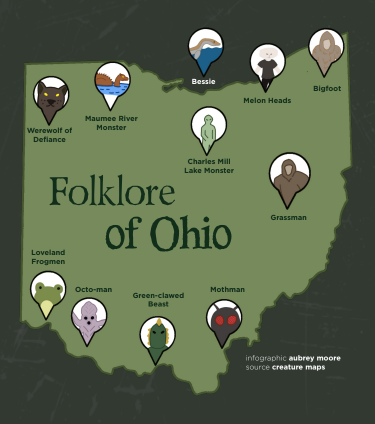
Ohio holds many tales of cryptids: Octoman, spotted along the Ohio River; Mothman, seen on the border of Ohio and West Virginia in Point Pleasant; and the Loveland Frogman, who was believed to be spotted near the Little Miami River.
Although some cryptids are widely known such as the Sasquatch and Yeti, the cryptid community is small. Two members of the community that go by Jenny Dreadful and Yoshi the Supplier of Nightmares base their band’s songs around these stories.
“[Cryptids] are a deep, cavernous well and they are everywhere all across the world,” Yoshi told Spark. “Since we are musicians and songwriters, we want to be sort of comedic, funny and lighthearted.”
The couple writes their songs in order to create a welcoming community of individuals interested in cryptids.
“We don’t want to alienate anyone. We want to welcome everyone, and [cryptids are] the perfect thing for us to write about because it is an endless well of different creatures,” said Yoshi.
The most popular cryptid in the Greater Cincinnati area, the Loveland Frogman, got so popular they made him into the city’s mascot.
“I grew up in Loveland and I didn’t realize until I went to college that there was a Loveland Frogman,” Jenny said. “I grew up all 18 years and I didn’t know that the Loveland Frogman was hopping around where I lived.”
The Loveland Frogman has also been rumored not just as the one man, but multiple, frog-people.
“They say Frogman but I’ve heard of multiple frogmen,” Jenny told Spark. “[The name] makes it sound like there is one but there is actually multiple.”
In one encounter, the Loveland frog was reported to be holding a stick with sparks coming out of its end, which some call a wand.
“The wand, I think, is because of the connection to maybe the supernatural,” said Jenny. “We have a heart at the end of the wand in one of our logos.”
Yoshi and Jenny abstain from harm or hate against cryptids; they promote peace and love toward cryptids through their songs by educating the public on the folklore around these creatures.
“We don’t sing about politics; we don’t sing about heartbreak or anything like that. We just sing about cryptids and try to tell the stories,” Yoshi said. “Mostly we are just promoting love by saying to ‘leave them alone’.”

A HISTORIC BRICK BUILDING, HIDDEN AMONGST THE TREES ABOVE THE BANKS OF THE LITTLE MIAMI RIVER, ONCE SERVED AS AN AMMUNITION MANUFACTURER AND IS NOW REFURBISHED INTO APARTMENTS AND A BREWERY.
Patrolling the dark and empty halls of Peters Cartridge Factory, the night guard passes from room to room with ease- at least, much easier than when he was living.
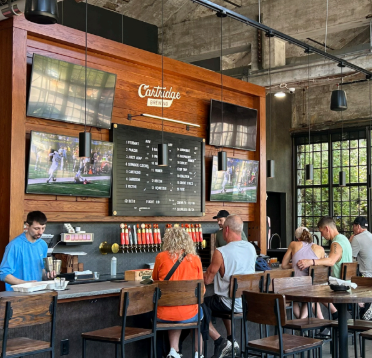
The night watchman is one of the ghostly legends that some believe haunt the halls under the brick tower that presides over the Little Miami River at 1409 Grandin Road in Maineville. Once an ammunition factory during World War II, the historic building has become home to residential apartments and Cartridge Brewing.
“I have heard myths and legends; there is a night watchman that supposedly people see at night,” General Manager of Cartridge Brewing Amanda Littleton told Spark.
The restaurant and brewery that Littleton runs has a wide range of flavor profiles and signature dishes, including the Night Guard’s Chili, a meal as rich in flavor as its name is in legend.
In 1890, there was a lethal explosion in the building that killed 12 people. Afterward, the factory continued to function and supplied ammunition during both World Wars. Starting in 1945, it went through different ownership until falling into disuse in 1968, according to the International Ammunition Association.
In 2020, Anthony Cook, Kyle Hackbarth, and Lindsey Hackbarth successfully opened the doors of the brewery.
According to Littleton, the historical environment is important to the brewery’s brand.
“I always say that when people walk in, it has that wow factor; it’s such a unique place located right by the Little Miami River, and it’s very much tucked away,” said Littleton. “It’s also a hidden gem because unless you knew it was there, you wouldn’t be looking for it.”
Along with food and alcohol, the brewery serves up hour-long tours that give the historical background of the building, a look into how beer is made at the brewery, and a taste test flight of beer.
Some locals are glad to see the historic building refurbished into a community gathering place.
“I mean, I love it,” an anonymous customer told Spark. “It is great to see the old place turned into something that people can enjoy today.”
The brewery may not have been able to continue during the pandemic if not for being bought by a parent company: Saucy Brew Works.
“After COVID, a lot of small businesses could not succeed on their own anymore,”
Saucy Brew Works Marketing Manager Amanda Kantor told Spark. “We started in Cleveland, Ohio, and we have multiple locations throughout the state of Ohio.”
Still, the acquisition did not change the heart of Cartridge Brewing, according to Kantor.
“We did some changes here and there, but it has still been Cartridge Brewing. I think [Littleton] has done a great job keeping it to its roots,” said Kantor. “[Saucy Brew Works] was there on the financial and management side of it, just putting protocols into place.”
Although labeled as a brewery, Kantor marks the establishment as welcoming to everyone.
“We are family friendly, so you’ll see a lot of families. We have a little outside patio that you can bring your dog on, and with people that are walking and biking on the trail, we have bike racks for them to come get a well deserved beer after biking,” said Kantor. “It’s a really inviting, comfortable space.”
Your donation will support the student journalists of Lakota East High School. Your contribution will allow us to cover our annual website hosting costs!